Key Takeaways
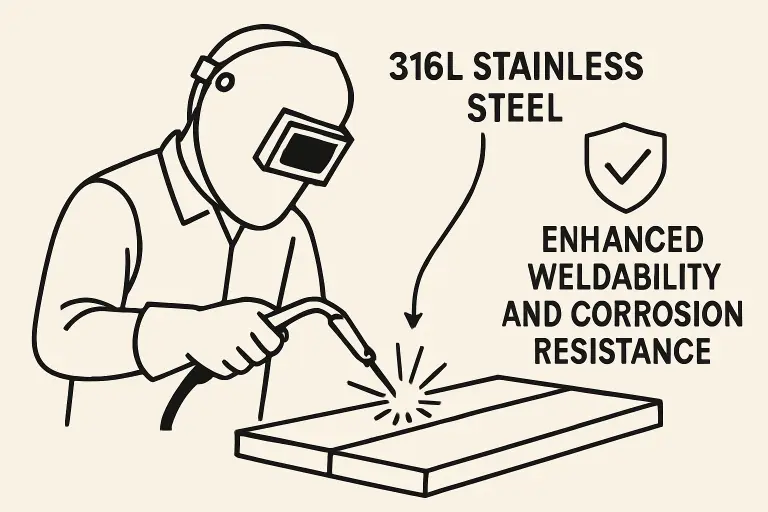
- 316L stainless steel’s low carbon content reduces carbide precipitation, significantly enhancing weldability and corrosion resistance.
- This alloy is ideal for sectors such as the marine, chemical, and pharmaceutical industries due to its ability to maintain integrity in welded joints.
- Best practices during welding, such as controlling heat input and performing post-weld cleaning, are crucial for optimizing material performance.
Introduction to 316L Stainless Steel
316L stainless steel stands out as an industry standard, favored for its combination of excellent corrosion resistance and mechanical properties. Unlike other grades, the low carbon content of 316L plays a crucial role in its performance, particularly in applications involving welding. For buyers seeking reliable supply and expertise, the Specialty Steel stainless steel distributor is a valuable partner in sourcing high-quality 316L stainless steel products.
The “L” in 316L signifies “Low Carbon,” and this seemingly minor reduction in carbon content is critical. It helps safeguard the material against welding-related issues that can compromise the structural integrity of components and reduce service life.
Understanding the Low-Carbon Advantage
Carbon is a crucial element in stainless steels, affecting properties such as hardness and strength. However, when welding austenitic stainless steels such as 316, higher carbon levels can result in the formation of chromium carbides along grain boundaries. This phenomenon—carbide precipitation—weakens the chromium oxide layer that gives stainless steel its corrosion resistance, leading to intergranular corrosion.
By maintaining a carbon content below 0.03% in 316L, carbide precipitation is minimized, even under the elevated temperatures encountered during welding. This preserves ductility, prevents embrittlement, and maintains corrosion resistance in critical environments, such as chemical plants and marine structures.
Enhanced Weldability of 316L Stainless Steel
Thanks to its low-carbon makeup, 316L is easier to weld and does not suffer from many of the weld decay problems associated with standard 316. The alloy is compatible with various welding techniques, including Tungsten Inert Gas (TIG), Metal Inert Gas (MIG), and Shielded Metal Arc Welding (SMAW). Pre-heating before welding is generally unnecessary, and post-weld annealing—often required for higher-carbon grades—can typically be skipped, reducing production time and costs.
According to a comprehensive guide by AZoM, the improved weldability enables manufacturers to fabricate complex structures with fewer post-weld treatments, making 316L a preferred choice for industries that demand both precision and durability.
Applications Benefiting from 316L’s Weldability
Industries where contamination control and corrosion resistance are paramount highly value the weldability of 316L stainless steel. In chemical processing, for example, piping and tanks made from 316L easily withstand frequent cleaning and exposure to corrosive chemicals. The pharmaceutical sector also relies on 316L for equipment that must be sterilized repeatedly, as smooth, defect-free welds are crucial for hygienic surfaces. Marine applications, where saltwater accelerates corrosion, benefit significantly from both the material’s corrosion resistance and the robust, reliable welded joints it enables.
Comparing 316L to Other Stainless Steel Grades
While 304 stainless steel is frequently used across numerous industries, it lacks the added molybdenum found in 316 and 316L, making it less effective against pitting and crevice corrosion in high-chloride environments. In contrast, the combination of low carbon and molybdenum content in 316L offers dual protection for both corrosion-prone and weld-intensive applications.
Considerations in Welding 316L Stainless Steel
Despite its excellent weldability, the best results are achieved by following certain guidelines:
- Heat Input Control: Limiting excessive heat input is critical to avoid warping, distortion, and changes to mechanical properties. Using proper technique preserves the alloy’s structure during welding.
- Filler Material Selection: Choosing a matching low-carbon filler, such as 316L or its equivalent, ensures uniform corrosion resistance throughout the entire structure, including weld seams.
- Post-Weld Cleaning: After welding, cleaning the weld zone removes discoloration and potential contaminants. This step helps restore the passive chromium oxide layer, maximizing performance in corrosive settings.
Final Thoughts
The significance of using 316L stainless steel, particularly in industries prone to corrosion and those requiring extensive welding, cannot be overstated. Its low carbon content not only prevents problems such as carbide precipitation but also simplifies fabrication and repairs in the field. With industries continually seeking safer, more reliable solutions in challenging environments, 316L stands out as a logical choice—delivering both exceptional weldability and lasting corrosion resistance.
For organizations prioritizing longevity and structural excellence in aggressive environments, 316L stainless steel offers a robust foundation for high-performance, future-proof applications.
Also Read-Innovations in Valve Technology for Industrial Applications