Key Takeaways
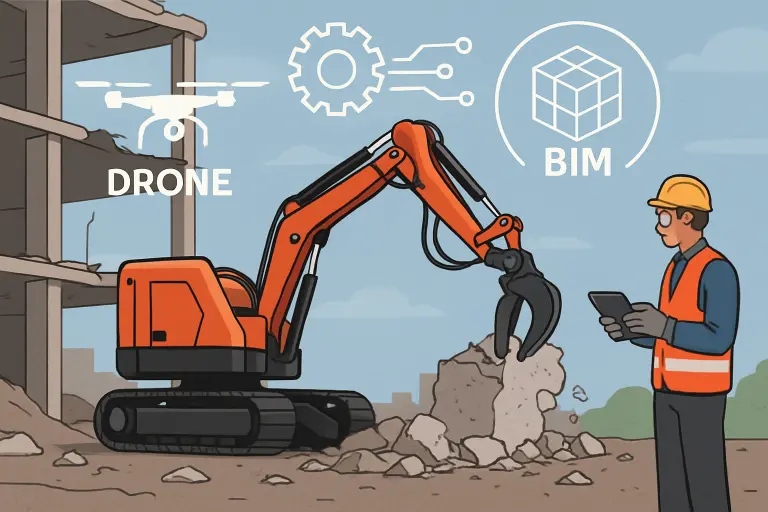
- Robotic Demolition: Revolutionizes safety with remote-controlled operation in hazardous spaces.
- Advanced Cutting Tools: Offer precision dismantling and reduced noise impact.
- Drones and 3D Mapping: Transforming Site Assessment and Project Monitoring.
- Building Information Modeling (BIM): Streamlines project planning and minimizes waste.
- Artificial Intelligence (AI): Optimizes demolition workflows with predictive analytics.
Modern Demolition: From Brute Force to Smart Solutions
Demolition has evolved from a blunt-force method to a technical operation focused on safety, efficiency, and resource management. Modern practices prioritize worker protection and aim to minimize disruption, benefiting stakeholders with faster and environmentally conscious processes. The rise in urban redevelopment demands precision, utilizing advanced technologies instead of traditional methods. These changes position demolition as a key component of smart construction and redevelopment, indicating a transformative era for the industry and paving the way for future innovations.
Robotic Demolition: Enhancing Safety and Precision
Remote-controlled and automated robots represent a significant advancement in demolition technology, enabling workers to perform high-risk tasks such as concrete cutting, debris removal, and even specialized operations like port demolition from a safe distance. These robots are especially effective in confined and hazardous environments, significantly reducing workplace injuries and boosting productivity. Their advanced sensors provide precise movements, making them crucial for projects with high safety standards. The use of robotics in demolition workflows demonstrates how technology can minimize operational risks while enhancing efficiency, leading to fewer delays and incidents within the industry.
Advanced Cutting Tools: Precision and Noise Reduction
Traditional methods, known for their loud and damaging approaches, are being outpaced by a new generation of advanced cutting tools. Diamond wire saws, hydraulic crushers, and high-frequency breakers have replaced jackhammers and explosives in many applications, especially in urban environments or sensitive facilities. These new tools mitigate vibration, control dust, and drastically reduce noise pollution, accommodating both workers and nearby residents.
The precision afforded by these state-of-the-art tools allows for selective demolition—such as retaining essential structural elements or dismantling specific building components without collateral damage. This capability is crucial in renovation and redevelopment projects, where adjoining structures must remain untouched.
Drones and 3D Mapping: Revolutionizing Site Assessments
The deployment of aerial drones and 3D mapping technology has fundamentally changed how demolition projects are assessed and managed. High-resolution imagery and interactive site models provide clear overviews, allowing teams to preempt hazards and coordinate large-scale operations with unprecedented accuracy. Throughout the demolition process, real-time drone surveillance ensures compliance with safety standards and instant visibility into progress.
These digital tools give project managers new insights for making data-driven decisions, improving efficiency, and communicating more effectively with stakeholders. Drone-enabled site reconnaissance has also become invaluable for insurance documentation and regulatory reporting, setting an emerging industry standard.
Building Information Modeling (BIM): Streamlining Project Planning
Building Information Modeling (BIM) provides digital blueprints that detail every aspect of a structure long before the first wall comes down. From sequencing dismantlement to estimating waste volume and optimizing recycling workflows, BIM reduces project uncertainties. Highly detailed, multilayer models help teams anticipate complications, enhance scheduling accuracy, and ensure full regulatory compliance.
In addition to simplifying cross-team collaboration, BIM has become essential for sustainable demolition, actively supporting zero-waste initiatives and facilitating circular construction economy targets.
Artificial Intelligence and Machine Learning: Optimizing Demolition Processes
Artificial Intelligence (AI) and Machine Learning (ML) are at the forefront of the digital revolution, making their mark in demolition by processing vast historical datasets and optimizing project outcomes. AI enables early identification of structural weaknesses, forecasting of material yields, and dynamic adjustment of work plans as site conditions evolve. ML empowers demolition robots to learn on the job, adapting control algorithms to unique scenarios for safer and more efficient operation.
As these technologies mature, the industry can expect greater standardization in safety practices and substantially reduced project timelines, providing value to both demolition contractors and their clients.
Environmental Considerations: Sustainable Demolition Practices
Sustainability is no longer optional—it’s a priority in modern demolition. Thoughtfully engineered equipment now sorts and separates hazardous materials, facilitating industry-leading recycling rates. Innovations in dust suppression, energy-efficient machinery, and waste diversion ensure that demolition sites comply with strict environmental guidelines. Large-scale government projects, such as those chronicled by the U.S. Environmental Protection Agency, provide models for prioritizing worker and ecosystem health throughout the demolition lifecycle.
Training and Certification: Ensuring Industry Standards
Keeping up with the pace of innovation demands up-to-date training and certification. Industry standards are continually evolving to meet technological and regulatory changes, making ongoing education essential for demolition contractors. Well-structured certification programs ensure the safe use of new equipment, proper waste disposal, and compliance with evolving safety and environmental standards.
By investing in their workforce, contractors not only enhance operational efficiency but also foster a culture of excellence throughout the construction and demolition landscape.
Conclusion
The demolition industry is undergoing a technology-driven transformation, striking a balance between innovation and responsibility. Tools like robotics, BIM, advanced cutters, drones, and AI are setting new benchmarks for how demolition is executed safely and efficiently. As the industry continues to evolve, staying informed and adaptive is key for professionals who aim to excel and lead in this dynamic field.
Also Read-Navigating Property Disputes: Effective Strategies for Homeowners